Drive Awake · Perspectives · Culture
The stolen hour
In 1917 an American poster urged people to move the clock and "gain an hour of daylight". A century on, we know the body does not move with the clock - and the bill comes due on the road too.
Entry · cultureLast revision: 26.09.2026
| 26.09.2026 | Current Biology study figures clarified |
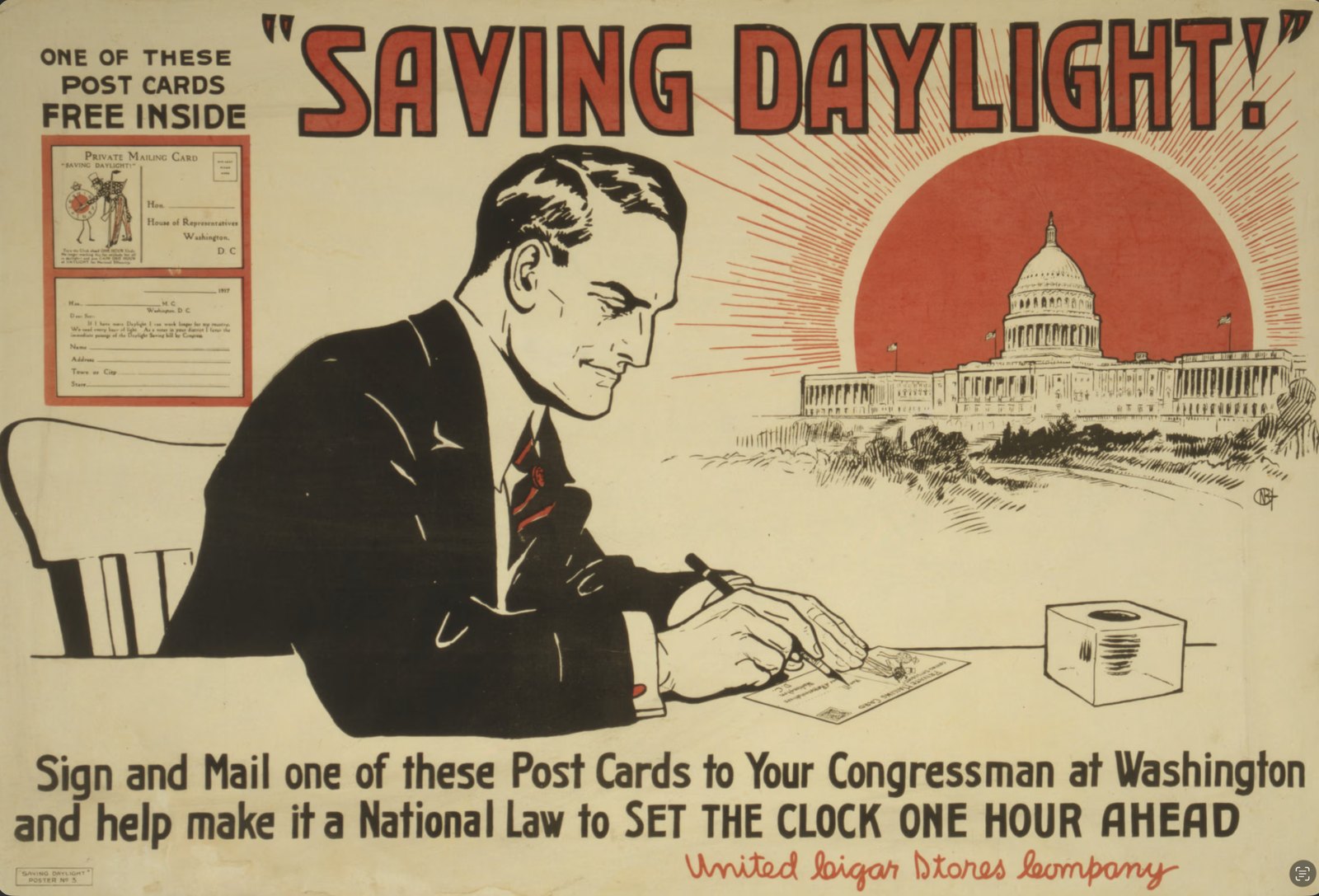
A poster, a promise
A man in a jacket writes a postcard to his congressman. Behind him, a huge sun rises over the Capitol. Above, in red: "Saving Daylight!". It is 1917, and the United Cigar Stores Company hands out ready-made postcards to mail to Congress: sign, post, and help make daylight saving a national law. "Set the clock one hour ahead." The promise is seductive: more evening light, more work, an hour gained. In wartime, moving the clock becomes almost a duty. The following year, in 1918, the United States adopts daylight saving time.
The wall clock and the body clock
There is something that poster could not know. A law moves the wall clock, not the body's. The circadian rhythm - the internal clock that governs sleep and alertness - keeps its own time. When we move the clock forward in spring, we gain nothing: we subtract an hour of sleep from an entire population, all at once. A small collective jet lag, imposed by decree. It is called daylight saving time, and the European Union has even debated abolishing it. The light shifts on the calendar; the body does not.
The bill, on the road too
This gap has a measurable cost. A study published in Current Biology in 2020, on twenty-two years of US data (1996-2017), found an increase in the risk of fatal road accidents in the days after the spring transition to daylight saving time, of about 6%, more pronounced in the morning (DOI: 10.1016/j.cub.2019.12.045). It is an association, not a verdict: the effect is modest, debated in the literature, and how far it applies to Switzerland is still open. But it says something simple: when we take an hour of sleep from everyone at once, sleepiness at the wheel does not ask permission.
Why it matters to us
We cannot stop the hands. We can see the window.
We cannot choose not to move the clock. But we can recognise the window in which the risk of sleepiness tends to be higher, and plan around it: delay departure, plan a break, sleep an hour more the night before the change. That is the point of the circadian signal tool: it does not measure the person, it shows when the body is most exposed. "Saving daylight" saved light; sometimes, unspoken, it spent sleep. Stay awake, at the wheel and in life.
Sources
United Cigar Stores Company, "Saving Daylight!", 1917. Poster, public domain (Library of Congress). Campaign for the adoption of daylight saving time; Standard Time Act, 1918.
Fritz J, VoPham T, Wright KP Jr, Vetter C. A Chronobiological Evaluation of the Acute Effects of Daylight Saving Time on Traffic Accident Risk. Current Biology, 2020 (DOI 10.1016/j.cub.2019.12.045).
Varughese J, Allen RP. Fatal accidents following changes in daylight savings time. Sleep Medicine, 2001.