Drive Awake · Perspectives · Culture
The sign that doesn't exist
There is a sign for nearly every danger on the road. Not for sleepiness. The story of an absence - and of a proposal.
Entry · proposalLast revision: 26.09.2026
| 26.09.2026 | Wording clarified |
The absence
There is a sign for nearly every danger on the road: falling rocks, animals crossing, side wind, icy surface. Signage has a symbol for each, and even one for "other dangers", those without a figure of their own. For sleepiness, none. Yet it is among the most common conditions behind serious crashes and, unlike the other dangers, it does not come from outside: it comes from inside the driver.
The signal that is arriving
While that symbol is missing on the road, inside the car a signal is arriving. The European vehicle safety regulation makes mandatory the systems that warn when the driver is sleepy or distracted: the sleepiness warning (DDAW) on new vehicles from 2024, the distraction warning from 2026 (Regulation (EU) 2019/2144). The car, in short, is learning to notice. The road around it, not yet. The signal is born in the cabin before it is on the asphalt.
Why it is missing
A sign points to an external danger, out there: a bend, a landslide, a narrowing. Sleepiness is different, because it arises within us, and admitting it is a small taboo. Sleeping little is still treated as an achievement, pushing through as virtue, stopping as weakness. You do not put up a sign for a danger we keep denying. The absence of the sign, before it is technical, is cultural.
The limit of proof
There is also a reason that concerns the law. Sleepiness is difficult to detect beforehand and difficult to establish afterward: it leaves no specific, standardised trace comparable to blood alcohol concentration. Today there is no roadside test in use, nor a validated biomarker able to reconstruct a case automatically; indirect elements remain - crash dynamics, absence of braking, EDR data, forensic reconstruction. Ten years ago, on the A2 near Quinto, the proceedings revealed severe sleep apnoea that the driver had not known about: a case built around a danger no one yet knew how to measure. Science is exploring that trace: research at the IRM in Zurich is investigating whether acute sleep deprivation leaves a detectable biochemical signature (DOI 10.1021/acs.jproteome.5c01064). This remains a laboratory proof of concept, not a validated roadside test. It is the biochemical signal beginning to arrive inside the body, as the electronic one arrives inside the car. Two signals on their way, and a road still silent.
The proposal
Not to reproduce signage. To invent the sign that is missing.
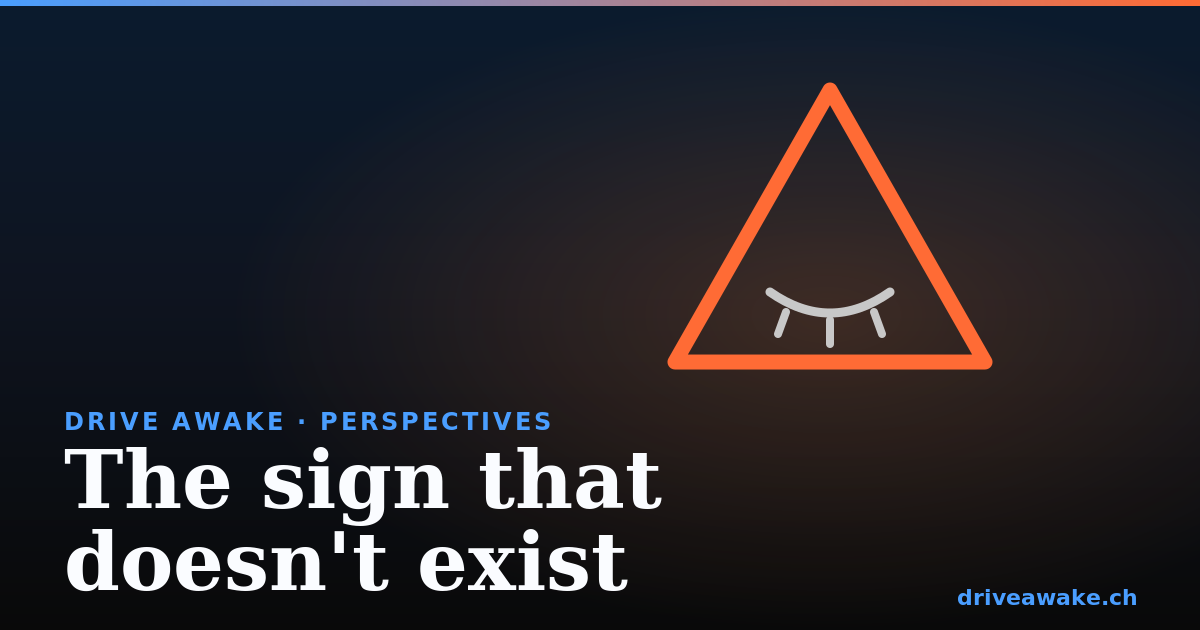
We do not claim to rewrite road signage: an official sign follows a precise path of ordinances and international conventions, and of expertise that is not ours. This is not an official road sign, but a cultural proposal: a campaign symbol designed to make an invisible risk visible. Any official use would require validation and an institutional path; in the meantime it can open a reflection and support prevention, modestly but seriously. Driving culture - and perhaps one day signage itself - can recognise sleepiness as it already recognises other dangers. The empty triangle is the shape of the warning, still to be filled: a new symbol for the one danger that has none.
And, while we wait for that sign to find its place on the road, we have built a first pocket-sized prototype of it: the circadian signal tool, which shows when the risk of sleepiness tends to be higher, before you set off. The sign does not yet exist on the road. For now, we have put it in your pocket.
A sign does not punish. It reminds. It does not look for someone to blame afterwards: it helps you stop before. That is the point - prevention, not prosecution. To give a place, in the shared language of the road, to a danger that until now has had no name.
Stay awake, at the wheel and in life.
Sources
EU sleepiness and distraction warning systems: Regulation (EU) 2019/2144 (DDAW from 2024, ADDW from 2026).
Sleepiness and crashes: Horne JA, Reyner LA, BMJ 1995 (DOI 10.1136/bmj.310.6979.565).
Salivary biomarkers of acute sleep deprivation: IRM Zürich (DOI 10.1021/acs.jproteome.5c01064).
Swiss Road Traffic Act (LCStr/SVG, RS 741.01), art. 31 - sleepiness is not named; it is covered as a general clause of unfitness to drive.
Catalogue of Swiss road signs - a sign for nearly every danger, none for sleepiness.
Quinto case: crash on the A2, undiagnosed sleep apnoea. Anniversary 26 July.