Circadian Adapted
This website adapts color temperature to your local time, reducing blue light exposure during evening hours.
Awareness Behind the Wheel
Drive Awake Awareness Behind the Wheel driveawake.ch
← The 24 Hours · All hours
Episode 11:00 Draft

The medication

Draft under review · open-air workshop · the campaign starts in November 2026

Watch in ITFRDEEN

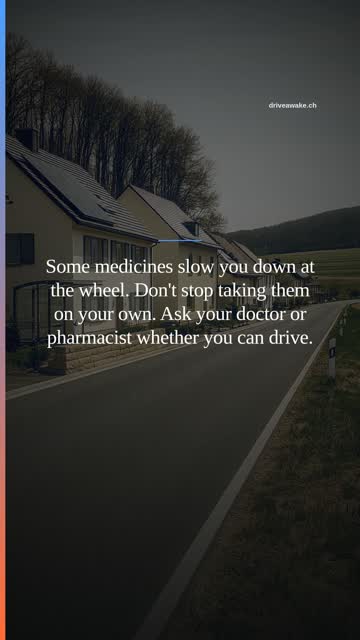
Some medicines slow you down at the wheel. Keep taking them. Ask your doctor whether you can drive.

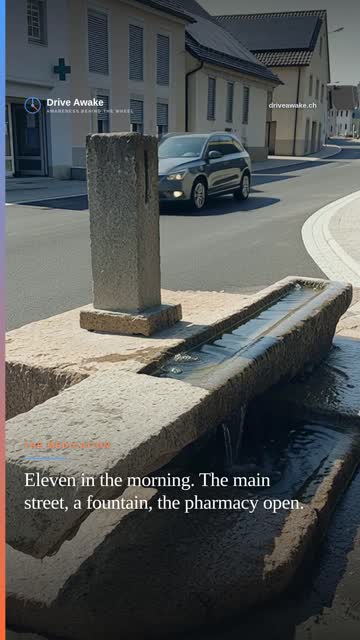
Eleven in the morning, a village in the Jura. A fountain, the main street, a pharmacy with its door open. This is the hour when people collect a medicine and then drive home. Some of the most ordinary boxes on those shelves reduce attention at the wheel, and the warning is there, in small print, on the side. If you take one of them, ask whoever prescribed it; don't stop taking it.

In the video

  1. 0:00The village
  2. 0:08The box
  3. 0:14Worse than alcohol
  4. 0:22The alternative
  5. 0:29The person
  6. 0:37The message

Details 51 s · 9:16 · four languages · generated and declared images · 2026-09-15 · Drive Awake

The video explained

The village · 0:00
0:00 · The village

Eleven in the morning. The main street, a fountain, the pharmacy open.

The hour is not incidental. Late morning is when people drive themselves to the pharmacy and back. The card shows an ordinary street because the problem is ordinary: nothing in the scene signals risk, and nothing is meant to.

Watch this passage (0:00) →
The box · 0:08
0:08 · The box

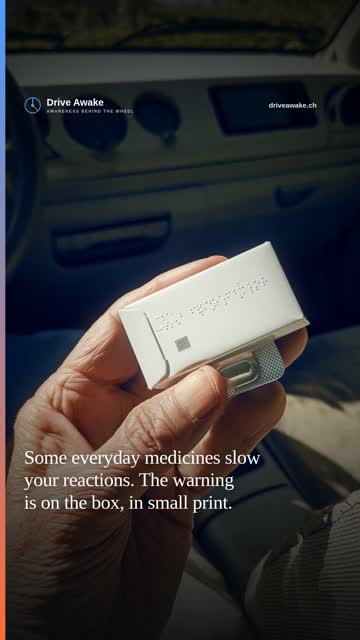
Some everyday medicines dull your reactions. The warning is on the box, in the small print.

The medicines in question are not exotic. First-generation antihistamines, some sedatives, some painkillers. The information is already printed on the box and in the leaflet, in small print.

Watch this passage (0:08) →
0:14 · Worse than alcohol

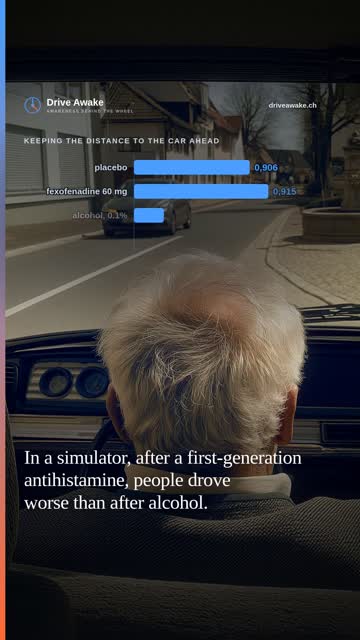
In a simulator, after an older antihistamine, people drove worse than after alcohol.

Weiler 2000: forty people, Iowa driving simulator, four conditions each. Coherence, the measure of how steadily you hold distance to the car ahead, fell to 0.877 after diphenhydramine 50 mg, against 0.920 at 0.1% blood alcohol and 0.906 on placebo. Worse than alcohol.

Weiler 2000 · DOI 10.7326/0003-4819-132-5-200003070-00004

Watch this passage (0:14) →
The alternative · 0:22
0:22 · The alternative

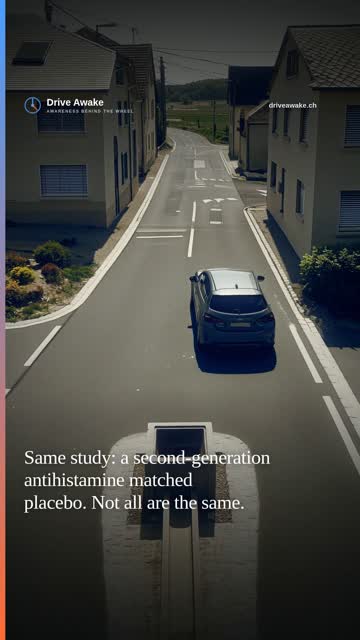
In the same study, a newer antihistamine matched placebo. Not all medicines are the same.

Fexofenadine 60 mg, second generation, scored 0.915 against placebo's 0.906 (Weiler 2000): not distinguishable. Same indication, opposite result at the wheel. The distinction between the two medicines is not hidden; it is written on the box the person is holding.

Watch this passage (0:22) →
The person · 0:29
0:29 · The person

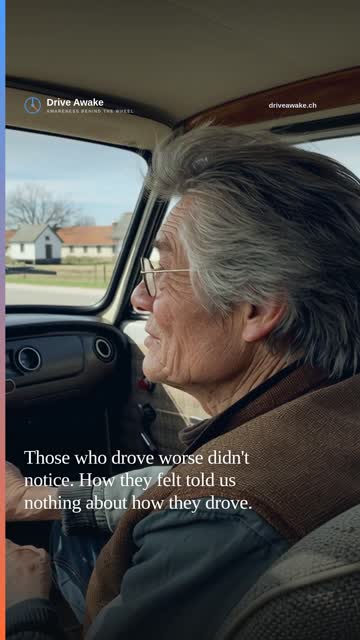
Those who drove worse didn't notice. How they felt said nothing about how they drove.

In the same study, reported sleepiness predicted driving weakly or not at all (Weiler 2000). The people driving worst were not the people who said they felt worst. This is the limit the whole series keeps returning to: what you feel does not measure what you do.

Watch this passage (0:29) →

What helps

A simulator is not a road. Forty people are not a population, and one dose is not a course of treatment. The study shows a mechanism, not your case. Whoever prescribes knows the alternative and knows when you can drive again. That conversation is the whole message.

Transcript
  1. 0:02 Eleven in the morning. The main street, a fountain, the pharmacy open.
  2. 0:09 Some everyday medicines dull your reactions. The warning is on the box, in the small print.
  3. 0:15 In a simulator, after an older antihistamine, people drove worse than after alcohol.
  4. 0:23 In the same study, a newer antihistamine matched placebo. Not all medicines are the same.
  5. 0:30 Those who drove worse didn't notice. How they felt said nothing about how they drove.
  6. 0:38 Some medicines slow you down at the wheel. Keep taking them. Ask your doctor whether you can drive.

Captions IT FR DE EN

Draft under review · the campaign starts in November 2026

This episode is a draft: we reread it and correct it before final publication. A mistake, a line that doesn't sound right, a figure worth checking: tell us below. We're getting this campaign right together.

Help us fix the mistakes
We keep nothing beyond what you write here.

Share this episode

The episode may be shared in full, as it is, with the Drive Awake signature and the link to this page. No cuts, no re-editing, no replacement of the audio, no advertising. The images are generated and declared as such. All rights remain with Drive Awake / Opening.

Paste this code: the video stays on the platform, with its signature.

Sources

  • Weiler JM, Bloomfield JR, Woodworth GG, et al. Effects of fexofenadine, diphenhydramine, and alcohol on driving performance. A randomized, placebo-controlled trial in the Iowa Driving Simulator. Ann Intern Med 2000;132:354-363. DOI: 10.7326/0003-4819-132-5-200003070-00004 simulator

Related

  1. 00
  2. 01
  3. 02
  4. 03
  5. 04
  6. 05
  7. 06
  8. 07
  9. 08
  10. 09
  11. 10
  12. 11
  13. 12
  14. 13
  15. 14
  16. 15
  17. 16
  18. 17
  19. 18
  20. 19
  21. 20
  22. 21
  23. 22
  24. 23

2026-09-15 · Drive Awake