Circadian Adapted
This website adapts color temperature to your local time, reducing blue light exposure during evening hours.
Awareness Behind the Wheel
Drive Awake Awareness Behind the Wheel driveawake.ch
← The 24 Hours · All hours
Episode 12:00 Draft

Midday

Draft under review · open-air workshop · the campaign starts in November 2026

Watch in ITFRDEEN

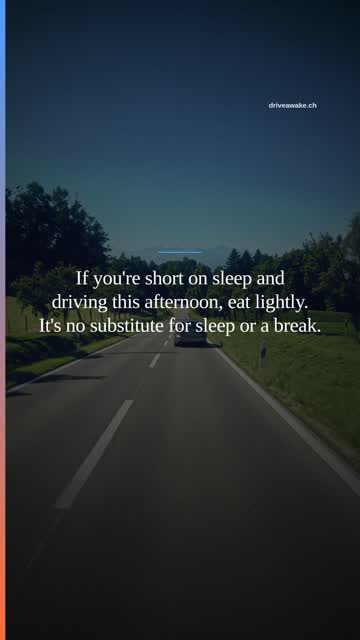
If you've slept little and you're driving this afternoon, eat light. It replaces neither sleep nor a stop.

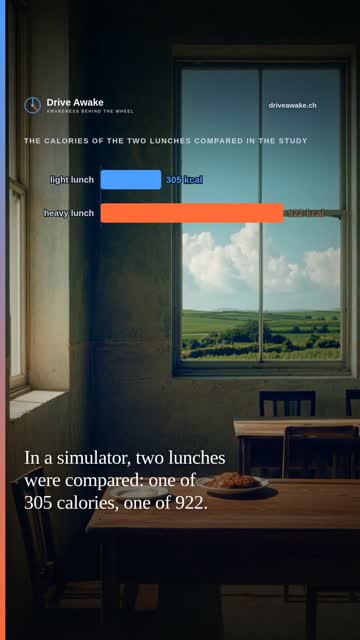
Midday on the Swiss plateau, small fields between hedgerows and rows of trees, a farm near the road. People eat, and in the afternoon they drive. In a simulator two lunches were compared, a light one of 305 calories and one of 922 with three times the fat: for the first half hour there was no difference, then lane drifting increased after the heavy meal. They were twelve young men who had slept five hours. In this study the heavy lunch deepened the sleepiness that was already there.

In the video

  1. 0:00The fields
  2. 0:08Two lunches
  3. 0:17After half an hour
  4. 0:26The limit
  5. 0:35The person
  6. 0:42The message

Details 56 s · 9:16 · four languages · generated and declared images · 2026-09-19 · Drive Awake

The text, in all four languages

The same lines you see in the video, side by side. This is where the gaps between languages show: a turn of phrase that does not hold, a word out of place, a figure that changes weight. If you find one, the button next to the line opens the report with hour, language and minute already filled in. All episodes on one page →

  1. line 1 0:01

    IT

    È mezzogiorno. Si mangia. Poi comincia la parte più lunga della giornata.

    FR

    Il est midi. On mange. Puis commence la partie la plus longue de la journée.

    DE

    Es ist Mittag. Man isst. Dann beginnt der längste Teil des Tages.

    EN

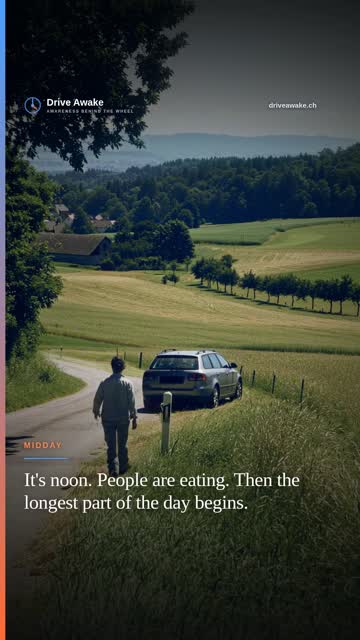
    It's noon. People are eating. Then the longest part of the day begins.

  2. line 2 0:09

    IT

    In un simulatore hanno confrontato due pranzi: uno leggero e uno tre volte più abbondante.

    FR

    Sur simulateur, on a comparé deux repas : un léger et un trois fois plus copieux.

    DE

    Im Simulator wurden zwei Mahlzeiten verglichen: eine leichte und eine dreimal so grosse.

    EN

    In a simulator, two lunches were compared: a light one and a heavy one with three times the calories.

  3. line 3 0:18

    IT

    Per la prima mezz'ora nessuna differenza. Dopo, con il pranzo pesante, aumentano le sbandate.

    FR

    La première demi-heure, aucune différence. Puis, avec le repas lourd, les écarts de trajectoire augmentent.

    DE

    Erste halbe Stunde: kein Unterschied. Dann, mit dem schweren Essen, mehr Spurabweichungen.

    EN

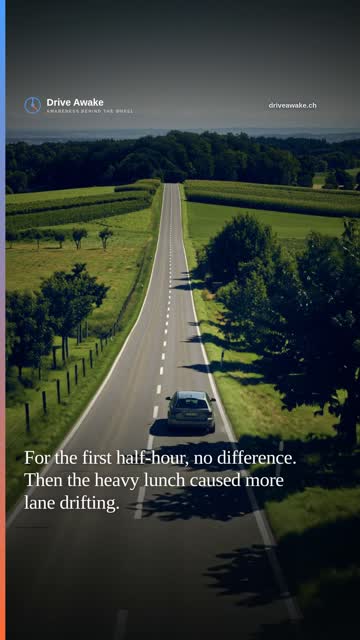
    For the first half-hour, no difference. Then the heavy lunch caused more lane drifting.

  4. line 4 0:27

    IT

    Tutti avevano dormito cinque ore. In questo studio il pranzo pesante ha aggravato la sonnolenza che c'era già.

    FR

    Tous avaient dormi cinq heures. Dans cette étude, le repas lourd a aggravé la somnolence déjà là.

    DE

    Alle hatten fünf Stunden geschlafen. In dieser Studie verstärkte das schwere Essen die Schläfrigkeit.

    EN

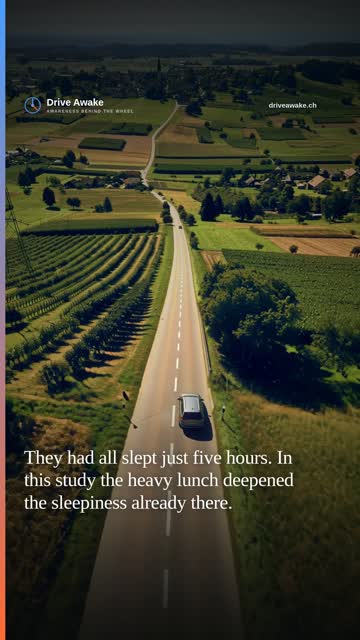
    They had all slept just five hours. In this study the heavy lunch deepened the sleepiness already there.

  5. line 5 0:35

    IT

    Nessuno pranza pensando al pomeriggio. È il momento in cui si può ancora decidere.

    FR

    Personne ne déjeune en pensant à l'après-midi. C'est le moment où l'on peut encore décider.

    DE

    Niemand denkt beim Essen an den Nachmittag. Es ist der Moment, in dem man noch wählen kann.

    EN

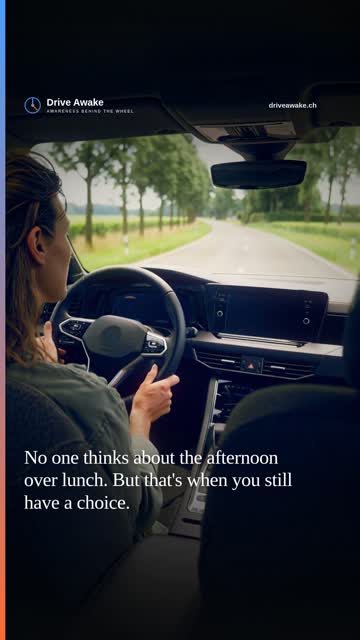
    No one thinks about the afternoon over lunch. But that's when you still have a choice.

  6. line 6 0:43

    IT

    Se hai dormito poco e nel pomeriggio guidi, mangia leggero. Non sostituisce il sonno né la sosta.

    FR

    Si tu as peu dormi et que tu conduis l'après-midi, mange léger. Cela ne remplace ni le sommeil ni la pause.

    DE

    Wenig geschlafen, am Nachmittag am Steuer: iss leicht. Das ersetzt weder Schlaf noch Pause.

    EN

    If you've slept little and you're driving this afternoon, eat light. It replaces neither sleep nor a stop.

The video explained

The fields · 0:00
0:00 · The fields

It's noon. People are eating. Then the longest part of the day begins.

The western plateau, between the Broye and the Gros-de-Vaud: small fields divided by hedgerows and rows of trees, a farm near the road, a wood closing the view a little further on. This is the hour when people stop to eat, and the afternoon of driving has not started yet.

Watch this passage (0:00) →
0:08 · Two lunches

In a simulator, two lunches were compared: a light one and a heavy one with three times the calories.

The study compares two lunches before a long, monotonous drive in a simulator. It is not a comparison between eating and not eating: it is between a light meal of about three hundred calories and one of over nine hundred.

Reyner 2012 · DOI 10.1016/j.physbeh.2011.11.025

Watch this passage (0:08) →
After half an hour · 0:17
0:17 · After half an hour

For the first half-hour, no difference. Then the heavy lunch caused more lane drifting.

The effect is not immediate. In the first half hour the two conditions look alike; only afterwards, with the heavy lunch, does the car begin to wander within the lane more often.

Watch this passage (0:17) →
The limit · 0:26
0:26 · The limit

They had all slept just five hours. In this study the heavy lunch deepened the sleepiness already there.

The limit of the study is stated: twelve young men, the previous night cut to five hours, in a simulator and not on the road. It applies to people who have already slept too little, and says nothing about those who slept well.

Watch this passage (0:26) →
The person · 0:35
0:35 · The person

No one thinks about the afternoon over lunch. But that's when you still have a choice.

People who drive for work eat in the middle of the day, not before a day out. Midday is the last moment when the choice is still easy: later, at the wheel, the only option left is to stop.

Watch this passage (0:35) →

What helps

It is not a ban and it is one thing only: if you are driving this afternoon, a light lunch is the choice that costs least. Sleep debt remains the main factor, and that is recovered only by sleeping.

Transcript
  1. 0:02 It's noon. People are eating. Then the longest part of the day begins.
  2. 0:09 In a simulator, two lunches were compared: a light one and a heavy one with three times the calories.
  3. 0:18 For the first half-hour, no difference. Then the heavy lunch caused more lane drifting.
  4. 0:27 They had all slept just five hours. In this study the heavy lunch deepened the sleepiness already there.
  5. 0:36 No one thinks about the afternoon over lunch. But that's when you still have a choice.
  6. 0:43 If you've slept little and you're driving this afternoon, eat light. It replaces neither sleep nor a stop.

Captions IT FR DE EN

Draft under review · the campaign starts in November 2026

This episode is a draft: we reread it and correct it before final publication. A mistake, a line that doesn't sound right, a figure worth checking: tell us below. We're getting this campaign right together.

Help us fix the mistakes

What happens next: every report is read. If it becomes a correction, the text changes here on the site and the correction goes into the episode's diary, with its date and its reason. The video plates are remade in the next production window: until then the video may still show the old line. Corrections already made →

We keep nothing beyond what you write here.

Sources

  • Reyner LA, Wells SJ, Mortlock V, Horne JA. 'Post-lunch' sleepiness during prolonged, monotonous driving - effects of meal size. Physiol Behav 2012;105(4):1088-1091. DOI: 10.1016/j.physbeh.2011.11.025 simulator

Related

  1. 00
  2. 01
  3. 02
  4. 03
  5. 04
  6. 05
  7. 06
  8. 07
  9. 08
  10. 09
  11. 10
  12. 11
  13. 12
  14. 13
  15. 14
  16. 15
  17. 16
  18. 17
  19. 18
  20. 19
  21. 20
  22. 21
  23. 22
  24. 23

2026-09-19 · Drive Awake