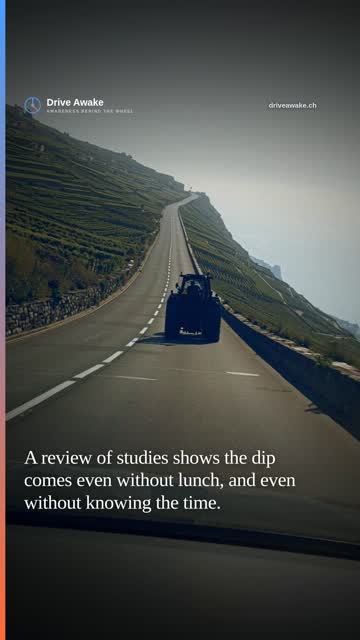
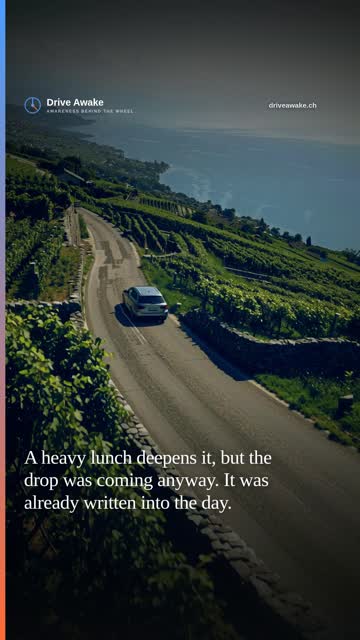
Just past one. The Lavaux road, between the vines and the lake. A tractor, and a car catching up with it.
One in the afternoon above Lavaux: the rows of vines run down to the lake and the road cuts across them halfway.
Watch this passage (0:00) →The text below is the current version. The video is the first version and will be remade: where the two differ, the text is what counts.
The afternoon dip is not the lunch's fault. If you drive at that time of day, plan for it.
One in the afternoon above Lavaux: the rows of vines run down to the lake and the road cuts across them. After lunch the mind slows down, and we usually blame the meal. Monk's review gathers the studies on the mid-day dip and shows that it comes even without lunch, and even when the person does not know the time: it has biological roots, possibly in the twelve-hour harmonic of the circadian system. A carbohydrate-heavy meal deepens it, but does not create it. The early-afternoon dip is therefore a matter of the clock, not the plate. Anyone driving in these hours can plan for it before setting off.
Details 57 s · 9:16 · four languages · generated and declared images · 2026-09-25 · Drive Awake
The same lines you see in the video, side by side. This is where the gaps between languages show: a turn of phrase that does not hold, a word out of place, a figure that changes weight. If you find one, the button next to the line opens the report with hour, language and minute already filled in. All episodes on one page →
line 1 0:01
IT
L'una passata. La strada di Lavaux, fra i filari e il lago. Un trattore, e un'auto che lo raggiunge.
FR
Une heure passée. La route de Lavaux, entre vignes et lac. Un tracteur, et une voiture qui le rattrape.
DE
Kurz nach eins. Die Strasse durch Lavaux, zwischen Reben und See. Ein Traktor. Ein Auto holt ihn ein.
EN
Just past one. The Lavaux road, between the vines and the lake. A tractor, and a car catching up with it.
line 2 0:11
IT
Dopo pranzo è la testa a rallentare. Di solito la colpa la diamo al piatto.
FR
Après le repas, c'est la tête qui ralentit. D'habitude on en accuse l'assiette.
DE
Nach dem Essen wird der Kopf langsamer. Schuld ist angeblich der Teller.
EN
After lunch it's the mind that slows down. We usually blame the food.
line 3 0:19
IT
Una rassegna di studi mostra che il calo arriva anche senza pranzo, e anche se non sai che ora è.
FR
Une revue d'études montre que le creux arrive même sans repas, et même sans savoir l'heure.
DE
Eine Übersichtsarbeit zeigt: der Tiefpunkt kommt auch ohne Mahlzeit und ohne zu wissen, wie spät es ist.
EN
A review of studies shows the dip comes even without lunch, and even without knowing the time.
line 4 0:28
IT
Il calo non arriva dal piatto. Arriva dall'orologio interno, che a metà giornata scende per conto suo.
FR
Ce n'est pas l'assiette : c'est l'horloge interne, qui baisse d'elle-même au milieu du jour.
DE
Es liegt nicht am Essen, sondern an der inneren Uhr, die mitten am Tag von selbst absinkt.
EN
It doesn't come from the food. It comes from the internal clock, which dips on its own in mid-day.
line 5 0:37
IT
Il pranzo pesante lo accentua, ma ci sarebbe stato comunque. Era già scritto nella giornata.
FR
Un repas lourd l'accentue, mais le creux était là de toute façon. Il était déjà inscrit dans la journée.
DE
Wer schwer isst, spürt es stärker. Aber das Tief gehörte ohnehin zum Tagesverlauf.
EN
A heavy lunch deepens it, but the drop was coming anyway. It was already written into the day.
line 6 0:45
IT
Il calo del pomeriggio non è colpa del pranzo. Se guidi in queste ore, tienine conto prima.
FR
Le creux de l'après-midi n'est pas la faute du repas. Si tu conduis à ces heures, tiens-en compte avant.
DE
Das Nachmittagstief kommt nicht vom Essen. Wer dann fährt, kann sich darauf einstellen.
EN
The afternoon dip is not the lunch's fault. If you drive at that time of day, plan for it.
Just past one. The Lavaux road, between the vines and the lake. A tractor, and a car catching up with it.
One in the afternoon above Lavaux: the rows of vines run down to the lake and the road cuts across them halfway.
Watch this passage (0:00) →
After lunch it's the mind that slows down. We usually blame the food.
After lunch the mind slows down, and the usual explanation is the meal just finished.
Watch this passage (0:10) →
A review of studies shows the dip comes even without lunch, and even without knowing the time.
Monk, 2005: a review of the studies on the mid-day dip. It appears even without lunch and even when the person does not know the time, and it is tied to the twelve-hour harmonic of the circadian system.
Watch this passage (0:18) →
It doesn't come from the food. It comes from the internal clock, which dips on its own in mid-day.
The dip does not come from the plate but from the internal clock, which drops on its own in the middle of the day.
Watch this passage (0:27) →
A heavy lunch deepens it, but the drop was coming anyway. It was already written into the day.
A carbohydrate-heavy lunch deepens the dip, but the dip was part of the day anyway. Anyone setting off now drives through it.
Watch this passage (0:36) →What helps is moving the drive, not pushing through it: if it can be done earlier or later, it is done earlier or later. When it cannot, the break goes inside those hours, not at the end of the route. A light meal does not cancel the dip, but it does not deepen it either.
This episode is a draft: we reread it and correct it before final publication. A mistake, a line that doesn't sound right, a figure worth checking: tell us below. We're getting this campaign right together.
What happens next: every report is read. If it becomes a correction, the text changes here on the site and the correction goes into the episode's diary, with its date and its reason. The video plates are remade in the next production window: until then the video may still show the old line. Corrections already made →
2026-09-25 · Drive Awake