Circadian Adapted
This website adapts color temperature to your local time, reducing blue light exposure during evening hours.
Awareness Behind the Wheel
Drive Awake Awareness Behind the Wheel driveawake.ch
← The 24 Hours · All hours
Episode 08:00

The commuter

Watch in ITFRDEEN

A long road costs you sleep, too. When you can't shorten the journey, protect your sleep.

Eight o'clock. The whole city is on the move. For many, the day started a while ago, on the road. A day is always twenty-four hours. The longer the journey, the less time for everything else. Sleep included. One extra hour of daily commuting can cost up to twenty-one minutes of sleep. One evening, it's not much. Day after day, it adds up to sleepiness. And sleepiness gets in the car with us. Commuters don't choose to sleep less. Often it's the road that decides, one day at a time.

In the video

  1. 0:00The city at 8
  2. 0:07The fixed hours
  3. 0:14Twenty-one minutes
  4. 0:20Day after day
  5. 0:27The person
  6. 0:34The message

Details 48 s · 9:16 · four languages · generated and declared images · 2026-09-08 · Drive Awake

The video explained

The city at 8 · 0:00
0:00 · The city at 8

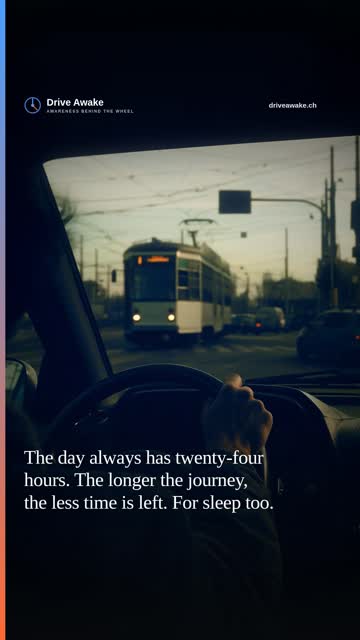
Eight o'clock. The whole city is on the move. For many, the day started a while ago, on the road.

The morning rush hour is an hour of driving for millions of people who have not yet started work. The commute is already part of the day, but nobody counts it as such.

Watch this passage (0:00) →
The fixed hours · 0:07
0:07 · The fixed hours

A day is always twenty-four hours. The longer the journey, the less time for everything else. Sleep included.

The day has twenty-four hours: commuting time is not added, it is subtracted. Time-use diaries show where it is taken from: work, sleep, free time.

Watch this passage (0:07) →
0:14 · Twenty-one minutes

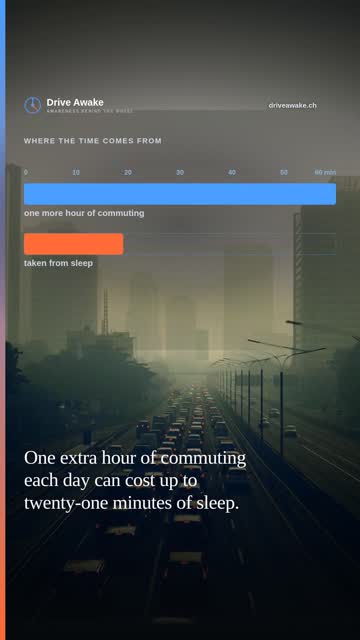
One extra hour of daily commuting can cost up to twenty-one minutes of sleep.

In the diaries of nearly 25,000 full-time workers, 28 to 35% of extra commuting time comes from sleep: for one extra hour a day, 17 to 21 minutes less sleep (Christian 2012). It is a population figure, not a driving one: it says how much sleep is lost, not how many crashes happen.

Christian 2012 · DOI 10.1007/s11524-012-9678-6

Watch this passage (0:14) →
Day after day · 0:20
0:20 · Day after day

One evening, it's not much. Day after day, it adds up to sleepiness. And sleepiness gets in the car with us.

Lost sleep adds up. In the laboratory, 48 adults slept six hours a night for two weeks: by the end, their attention was that of someone who had gone up to two nights without sleep. And they did not notice: the sleepiness they felt stayed almost the same while performance kept falling (Van Dongen 2003). It is the same mechanism as episode 01.

Watch this passage (0:20) →
The person · 0:27
0:27 · The person

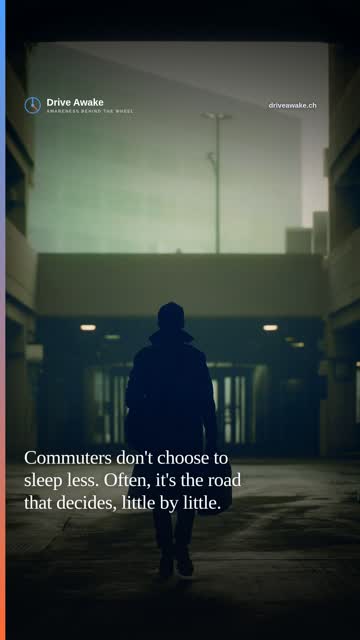
Commuters don't choose to sleep less. Often it's the road that decides, one day at a time.

The commuter's lost sleep is not a choice, it is a leftover. Recognising this makes it possible to protect sleep the way you protect an appointment.

Watch this passage (0:27) →

What helps

The night before a long drive is the one to protect: the debt cannot be seen from the inside (Van Dongen 2003). If sleepiness arrives on the road, a 10 to 20 minute nap in a rest area works better than anything else (Brooks and Lack 2006). If the commute cannot be shortened, something else can be moved: sleep is the last thing to cut, not the first.

Transcript
  1. 0:01 Eight o'clock. The whole city is on the move. For many, the day started a while ago, on the road.
  2. 0:08 A day is always twenty-four hours. The longer the journey, the less time for everything else. Sleep included.
  3. 0:15 One extra hour of daily commuting can cost up to twenty-one minutes of sleep.
  4. 0:22 One evening, it's not much. Day after day, it adds up to sleepiness. And sleepiness gets in the car with us.
  5. 0:28 Commuters don't choose to sleep less. Often it's the road that decides, one day at a time.
  6. 0:35 A long road costs you sleep, too. When you can't shorten the journey, protect your sleep.

Captions IT FR DE EN

Share this episode

The episode may be shared in full, as it is, with the Drive Awake signature and the link to this page. No cuts, no re-editing, no replacement of the audio, no advertising. The images are generated and declared as such. All rights remain with Drive Awake / Opening.

Paste this code: the video stays on the platform, with its signature.

Sources

  • Christian TJ. Trade-offs between commuting time and health-related activities. J Urban Health 2012;89:746-757. DOI: 10.1007/s11524-012-9678-6 laboratory
  • Basner M, Fomberstein KM, Razavi FM, et al. American time use survey: sleep time and its relationship to waking activities. Sleep 2007;30:1085-1095. DOI: 10.1093/sleep/30.9.1085 laboratory
  • Van Dongen HPA, Maislin G, Mullington JM, Dinges DF. The cumulative cost of additional wakefulness: dose-response effects on neurobehavioral functions and sleep physiology from chronic sleep restriction and total sleep deprivation. Sleep 2003;26:117-126. DOI: 10.1093/sleep/26.2.117 laboratory
  • Brooks A, Lack L. A brief afternoon nap following nocturnal sleep restriction: which nap duration is most recuperative? Sleep 2006;29:831-840. DOI: 10.1093/sleep/29.6.831 laboratory

Related

  1. 00
  2. 01
  3. 02
  4. 03
  5. 04
  6. 05
  7. 06
  8. 07
  9. 08
  10. 09
  11. 10
  12. 11
  13. 12
  14. 13
  15. 14
  16. 15
  17. 16
  18. 17
  19. 18
  20. 19
  21. 20
  22. 21
  23. 22
  24. 23

2026-09-08 · Drive Awake