Awareness Behind the Wheel
← The 24 Hours · All hours · 24 of 24 online
Episode 08:00 Online

The commuter

Online · version of 01.10.2026 · on our channels on 31.10.2026

Watch in ITFRDEEN

The 24 Hours

  1. 01
  2. 02
  3. 03
  4. 04
  5. 05
  6. 06
  7. 07
  8. 08
  9. 09
  10. 10
  11. 11
  12. 12
  13. 13
  14. 14
  15. 15
  16. 16
  17. 17
  18. 18
  19. 19
  20. 20
  21. 21
  22. 22
  23. 23
  24. 00

A long journey takes away part of your sleep. If you can't shorten it, protect what's left.

8 am. The whole city is on the move. For many, the day started a while ago, on the road. A day is always twenty-four hours. The longer the journey, the less time for everything else. Sleep included. One extra hour of daily commuting can cost up to twenty-one minutes of sleep. One evening, it's not much. Day after day, it adds up to sleepiness. And sleepiness gets in the car with us. Commuters don't choose to sleep less. Often it's the road that decides, one day at a time.

In the video

  1. 0:00The city at 8
  2. 0:10The fixed hours
  3. 0:19Twenty-one minutes
  4. 0:26Day after day
  5. 0:35The person
  6. 0:43The message

Details 57 s · 9:16 · four languages · generated images, voice and music, declared as such · 2026-09-08 · Drive Awake

What helps

The night before a long drive is the one to protect: the debt cannot be seen from the inside (Van Dongen 2003). If sleepiness arrives on the road, a short nap in a rest area helps: ten minutes of sleep work at once, twenty a little later (Brooks and Lack 2006, in the lab). If the commute cannot be shortened, something else can be moved: sleep is the last thing to cut, not the first.

The video explained

5 scenes, with notes and sources
The city at 8 · 0:00
0:00 · The city at 8

8 am. The whole city is on the move. For many, the day started a while ago, on the road.

The morning rush hour is an hour of driving for millions of people who have not yet started work. The commute is already part of the day, but nobody counts it as such.

Watch this passage (0:00) →
The fixed hours · 0:10
0:10 · The fixed hours

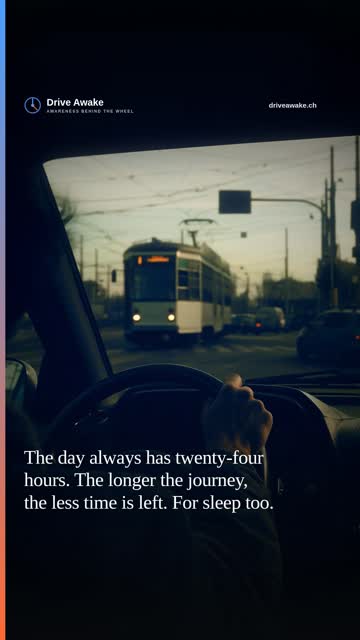
The day always has twenty-four hours. The longer the journey, the less time is left. For sleep too.

The day has twenty-four hours: commuting time is not added, it is subtracted. Time-use diaries show where it is taken from: work, sleep, free time.

Watch this passage (0:10) →
0:19 · Twenty-one minutes

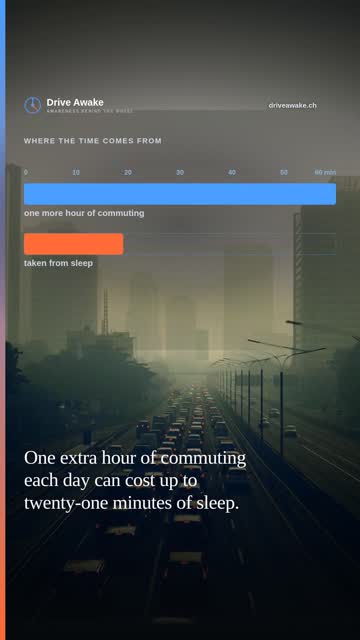
One extra hour of commuting each day can cost up to twenty-one minutes of sleep.

In the diaries of nearly 25,000 full-time workers, 28 to 35% of extra commuting time comes from sleep: for one extra hour a day, 17 to 21 minutes less sleep (Christian 2012). It is a population figure, not a driving one: it says how much sleep is lost, not how many crashes happen.

Christian 2012 · DOI 10.1007/s11524-012-9678-6

Watch this passage (0:19) →
Day after day · 0:26
0:26 · Day after day

One evening, they seem few. But day after day they add up. And sleepiness gets in the car with us.

Lost sleep adds up. In the laboratory, 48 adults slept six hours a night for two weeks: by the end, their attention was that of someone who had gone up to two nights without sleep. And they did not notice: the sleepiness they felt stayed almost the same while performance kept falling (Van Dongen 2003). It is the same mechanism as episode 01.

Watch this passage (0:26) →
The person · 0:35
0:35 · The person

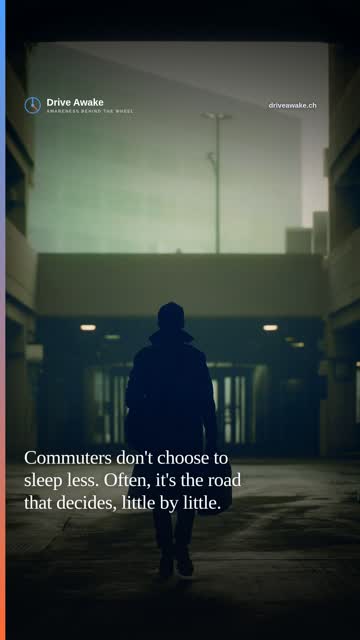
Commuters don't choose to sleep less. Often, it's the road that decides, little by little.

The commuter's lost sleep is not a choice, it is a leftover. Recognising this makes it possible to protect sleep the way you protect an appointment.

Watch this passage (0:35) →

What changed in this text

3 corrections · the latest on 01.10.2026

The corrections made to this text, with their date, their reason and the lines they touched.

  1. 16.09.2026Reported by RoadCross, resolved with George Zisa

    «Protect your sleep» did not say what to do

    Thomas Ruckstuhl had not reported a sentence but a phrase: «protect your sleep» does not say what to do. It appeared in two English closing lines. In hour 07 George Zisa rewrote it naming the action: make sure you are rested before getting behind the wheel. In hour 08 the same closing line could not be repeated two episodes apart, so it now says not to shorten your sleep when you cannot shorten the drive. Searched through the whole text: none left.

    Lines touched EN line 6

  2. 16.09.2026Two-engine blind test, with a calibration set

    Four loan translations, in Italian, German and French

    The lines of every hour online went past two judges with no context, mixed in with certified sentences written by native speakers. Only the four whose reason names a mistake anyone can check were applied: «piu tempo prende il viaggio» was a loan translation of «it takes time»; «non e poca volonta» is ungrammatical; the German talked around «Nachtschicht», a word the same episode already uses twice; in French «le total» is arithmetic and follows nobody to bed.

    Lines touched IT line 2

  3. 01.10.2026New version of the 10 am, 9 am and 8 am episodes

    10 am, 9 am and 8 am: six boards and the corrected lines in the videos

    Three hours already online go back into the edit, and with them come the lines corrected after the first release. Hour 08 gets two revised French lines, two revised German lines and three English lines by George. Hours 09 and 10 get George's English lines and, in hour 10, one French line. Episodes 09 and 10 go from eleven and eight boards respectively to six: we keep lines that were already there and write no new ones.

    Lines touched EN line 3, FR line 4, DE line 4, FR line 5, DE line 5, EN line 5, EN line 6

Revisions that concern the whole series are in the campaign diary →

Every line, in all four languages →

The text, in all four languages

6 lines

The same lines you see in the video, side by side. This is where the gaps between languages show: a turn of phrase that does not hold, a word out of place, a figure that changes weight. If you find one, the button next to the line opens the report with hour, language and minute already filled in. All episodes on one page →

  1. line 1 0:01

    IT

    Sono le otto. La città si muove tutta insieme. Per molti, la giornata è cominciata da un pezzo, in strada.

    FR

    Huit heures. Toute la ville bouge à la fois. Pour beaucoup, la journée a commencé bien avant, sur la route.

    DE

    Es ist acht Uhr. Die ganze Stadt ist unterwegs. Für viele hat der Tag längst begonnen, auf der Strasse.

    EN

    8 am. The whole city is on the move. For many, the day started a while ago, on the road.

  2. line 2 0:10

    IT

    La giornata ha sempre ventiquattro ore. Più il viaggio è lungo, meno tempo resta. Anche per dormire.

    FR

    La journée a toujours vingt-quatre heures. Plus le trajet est long, moins il reste de temps. Pour dormir aussi.

    DE

    Der Tag hat immer vierundzwanzig Stunden. Je länger der Weg, desto weniger Zeit. Auch zum Schlafen.

    EN

    The day always has twenty-four hours. The longer the journey, the less time is left. For sleep too.

  3. line 3 0:19

    IT

    Un'ora in più di viaggio al giorno può costare fino a ventuno minuti di sonno.

    FR

    Une heure de trajet en plus par jour peut coûter jusqu'à vingt et une minutes de sommeil.

    DE

    Eine Stunde mehr Pendelzeit pro Tag kann bis zu einundzwanzig Minuten Schlaf kosten.

    EN

    One extra hour of commuting each day can cost up to twenty-one minutes of sleep.

  4. line 4 0:27

    IT

    Una sera sembrano pochi. Ma giorno dopo giorno si accumulano. E la sonnolenza sale in auto con noi.

    FR

    Un soir, ça semble peu. Jour après jour, ça s'accumule. Et la somnolence monte en voiture avec nous.

    DE

    Ein Abend scheint wenig. Doch Tag für Tag summiert es sich. Und die Schläfrigkeit steigt mit ins Auto ein.

    EN

    One evening, they seem few. But day after day they add up. And sleepiness gets in the car with us.

  5. line 5 0:35

    IT

    Chi fa il pendolare non sceglie di dormire meno. Spesso è la strada a deciderlo, un giorno alla volta.

    FR

    Les pendulaires ne choisissent pas de dormir moins. Souvent, c'est la route qui décide, jour après jour.

    DE

    Wer pendelt, schläft nicht freiwillig weniger. Oft entscheidet das die Strasse, Tag für Tag.

    EN

    Commuters don't choose to sleep less. Often, it's the road that decides, little by little.

  6. line 6 0:44

    IT

    Il viaggio lungo si prende una parte del sonno. Se non puoi accorciarlo, proteggi il resto.

    FR

    Le long trajet prend une part du sommeil. Si tu ne peux pas le raccourcir, protège ce qui reste.

    DE

    Der lange Weg nimmt sich einen Teil des Schlafs. Wenn du ihn nicht kürzen kannst, schütze den Rest.

    EN

    A long journey takes away part of your sleep. If you can't shorten it, protect what's left.

Transcript
  1. 0:02 8 am. The whole city is on the move. For many, the day started a while ago, on the road.
  2. 0:11 The day always has twenty-four hours. The longer the journey, the less time is left. For sleep too.
  3. 0:20 One extra hour of commuting each day can cost up to twenty-one minutes of sleep.
  4. 0:28 One evening, they seem few. But day after day they add up. And sleepiness gets in the car with us.
  5. 0:36 Commuters don't choose to sleep less. Often, it's the road that decides, little by little.
  6. 0:44 A long journey takes away part of your sleep. If you can't shorten it, protect what's left.

Captions IT FR DE EN

A question about this hour · 08:00

How much time do you spend travelling each day, and how does it fit with the rest of your day?

There is no right answer: we are interested in the experience of people who drive, including for work.

The conversations happen on our channels. When there is one about this hour, we will link to it here.

Reply on our channels: Instagram Facebook LinkedIn YouTube TikTok Telegram

Online · always open to reports

This episode is online. If something feels off, a word, a figure, a detail in the image, tell us below: two lines are enough. We read everything, and every correction goes into the diary, with its date.

Tell us what you noticed

We read every message. If it becomes a correction, the text changes here on the site and goes into the episode's diary, with its date and its reason. Corrections already made →

Details, if you like
We keep nothing beyond what you write here.

Sources

  • Christian TJ. Trade-offs between commuting time and health-related activities. J Urban Health 2012;89:746-757. DOI: 10.1007/s11524-012-9678-6 obs
  • Basner M, Fomberstein KM, Razavi FM, et al. American time use survey: sleep time and its relationship to waking activities. Sleep 2007;30:1085-1095. DOI: 10.1093/sleep/30.9.1085 obs
  • Van Dongen HPA, Maislin G, Mullington JM, Dinges DF. The cumulative cost of additional wakefulness: dose-response effects on neurobehavioral functions and sleep physiology from chronic sleep restriction and total sleep deprivation. Sleep 2003;26:117-126. DOI: 10.1093/sleep/26.2.117 laboratory
  • Brooks A, Lack L. A brief afternoon nap following nocturnal sleep restriction: which nap duration is most recuperative? Sleep 2006;29:831-840. DOI: 10.1093/sleep/29.6.831 laboratory

Related

  1. 00
  2. 01
  3. 02
  4. 03
  5. 04
  6. 05
  7. 06
  8. 07
  9. 08
  10. 09
  11. 10
  12. 11
  13. 12
  14. 13
  15. 14
  16. 15
  17. 16
  18. 17
  19. 18
  20. 19
  21. 20
  22. 21
  23. 22
  24. 23

2026-09-08 · Drive Awake