Home · Sleep Science · Obstructive Sleep Apnoea
Obstructive Sleep Apnoea
Repeated interruptions of breathing during sleep, caused by partial or total obstruction of the upper airway. Often undiagnosed for years.
Last revision: 19.07.2026
| 19.07.2026 | OG image redrawn in the series style |
In the HypnoLaus study in Lausanne, among people aged 40 to 85, at least moderate sleep-disordered breathing was found in nearly half of men and about a quarter of women; the authors note that current criteria are very sensitive (Heinzer 2015). Untreated, people who have it face a higher crash risk (Tregear 2009).
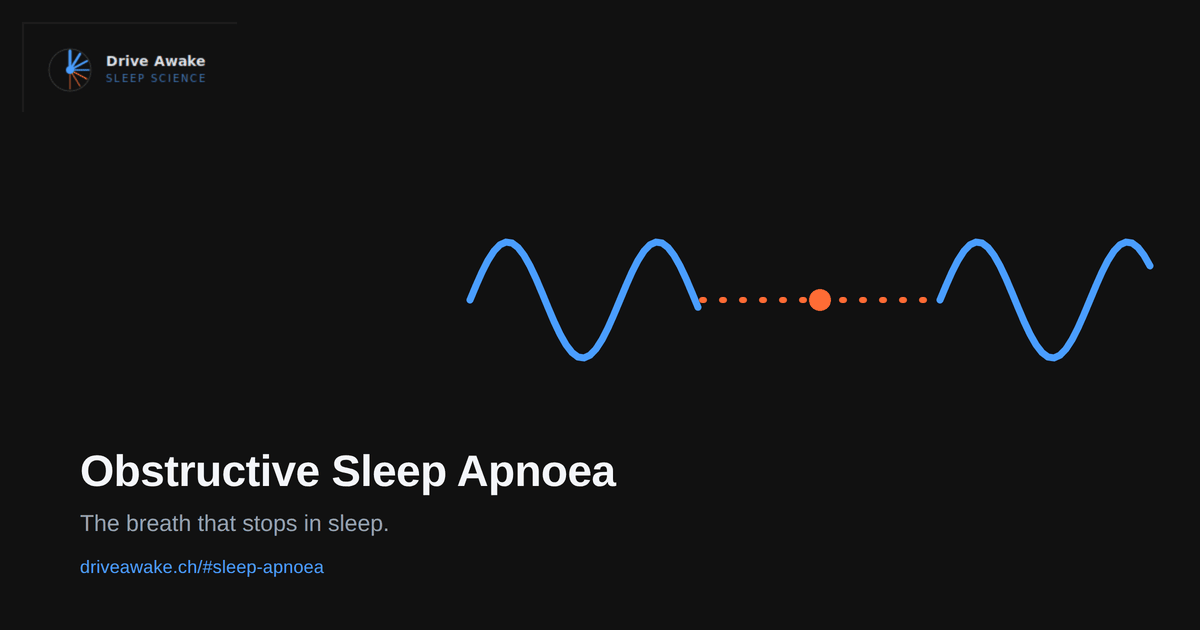
During sleep, throat muscles relax and partially block the airway. Breathing stops for seconds or minutes, causing oxygen drops and micro-arousals. The person rarely wakes fully but sleep quality is severely disrupted. Daytime sleepiness follows - often without the person recognising it as a medical condition.
A driver with undiagnosed apnoea may feel reasonably alert and still underestimate their sleepiness. That is why recognising it matters: apnoea is diagnosed with a sleep study, and it can be treated.
In the Quinto case (A2, 26 July 2016), the driver had severe obstructive sleep apnoea, diagnosed after the crash and confirmed by the sleep centre in Lugano. The criminal proceedings ended in an acquittal, which implies no broader conclusion about what happened. Even today, no roadside test measures sleepiness.