Home · Sleep Science · Social Jet Lag
Social Jet Lag
The chronic conflict between the biological clock and modern schedules. Work, school, artificial light and technology can profoundly alter circadian rhythms.
Last revision: 19.07.2026
| 19.07.2026 | OG image redrawn in the series style |
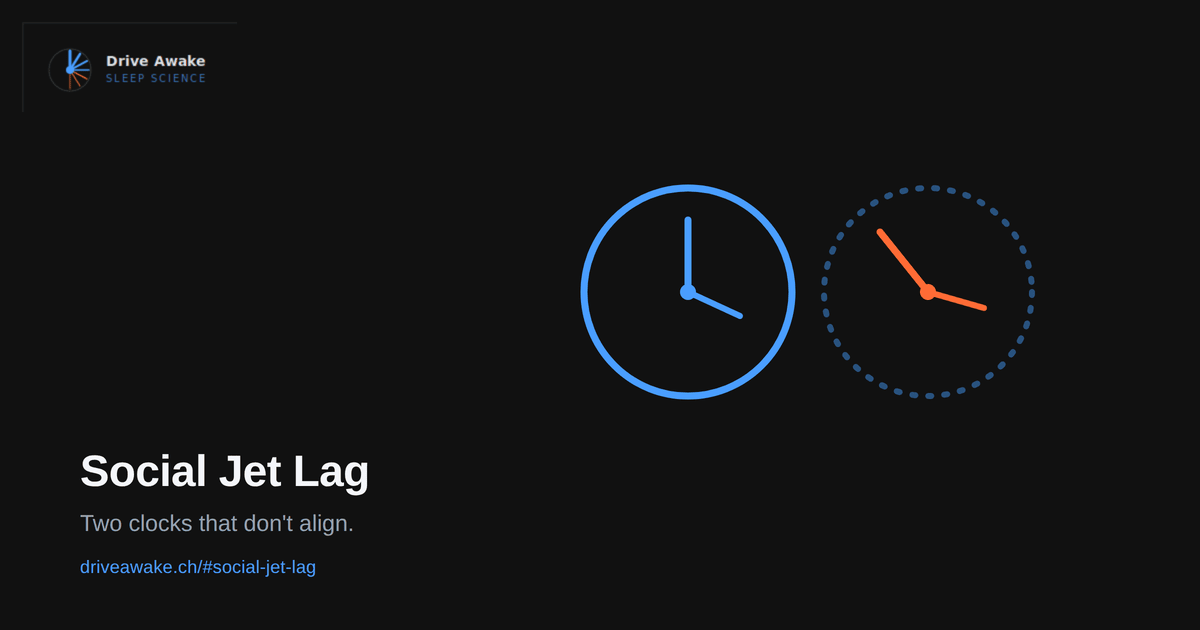
Contributes to a chronic sleep debt, reduced cognitive performance and increased road risk - particularly among shift workers and young adults.
Every person has an internal clock (circadian rhythm) that regulates sleep and wakefulness across a 24-hour cycle. When social obligations - work schedules, school hours, night shifts - force wakefulness outside this window, the body accumulates a sleep debt. The effect is equivalent to crossing time zones repeatedly, every week.
Shift workers and young adults are particularly at risk. On Monday morning, after a weekend of late nights and late mornings, the sleep debt is felt at the wheel too. The driver may feel awake yet be operating on significantly reduced cognitive capacity.
Drive Awake explored social jet lag through interviews at the World Sleep Forum 2025 at Monte Verità, Ascona - one of the leading gatherings of sleep scientists globally.