
Circadian Adapted
This website adapts color temperature to your local time, reducing blue light exposure during evening hours.
Awareness Behind the Wheel
Drive Awake Awareness Behind the Wheel driveawake.ch
← The 24 Hours · All hours
Episode 07:00

School and the road

Watch in ITFRDEEN

At eighteen you can drive. But you still need to sleep. Protect your sleep before you leave.

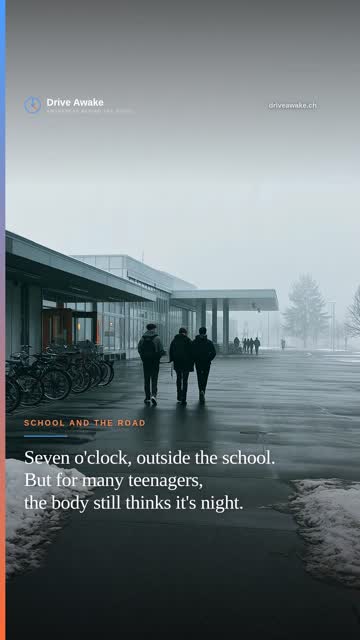
Seven o'clock, outside the school. But for many teenagers, the body still thinks it's night. In the teenage years, the body clock shifts later. You fall asleep later, and waking up gets harder. At eighteen, you're old enough to drive. But at seven, you may not be fully alert yet. It's not laziness. It's the natural rhythm of a body that is changing. And when that body gets behind the wheel, sleepiness is everyone's business.

In the video

  1. 0:00In front of the school
  2. 0:07The shifted clock
  3. 0:14At seven
  4. 0:20Not laziness
  5. 0:27Behind the wheel
  6. 0:34The message

Details 48 s · 9:16 · four languages · generated and declared images · 2026-09-08 · Drive Awake

The video explained

In front of the school · 0:00
0:00 · In front of the school

Seven o'clock, outside the school. But for many teenagers, the body still thinks it's night.

School starts while a teenager's body clock is still in its night. It is not a matter of will: it is the body's rhythm at that age.

Watch this passage (0:00) →
0:07 · The shifted clock

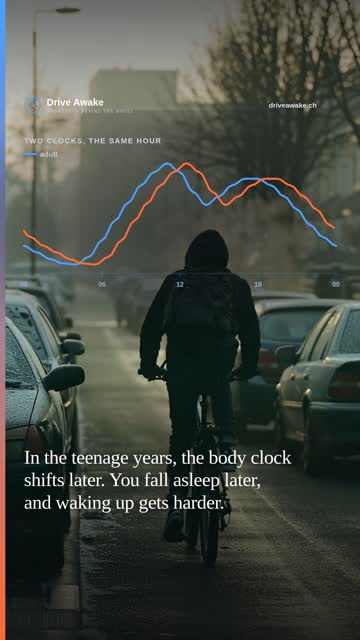
In the teenage years, the body clock shifts later. You fall asleep later, and waking up gets harder.

The clock shifts later for biological reasons, not because of bad habits. The delay grows with puberty and peaks around 19-20, earlier in girls than in boys: a habit would not have such a precise, sex-specific peak. In the diaries of over 50,000 people, at 17-18 the midpoint of sleep on free days falls around 4:30; between 25 and 65 it lies between 4 and 3 (Fischer 2017).

Fischer 2017 · DOI 10.1371/journal.pone.0178782

Watch this passage (0:07) →
At seven · 0:14
0:14 · At seven

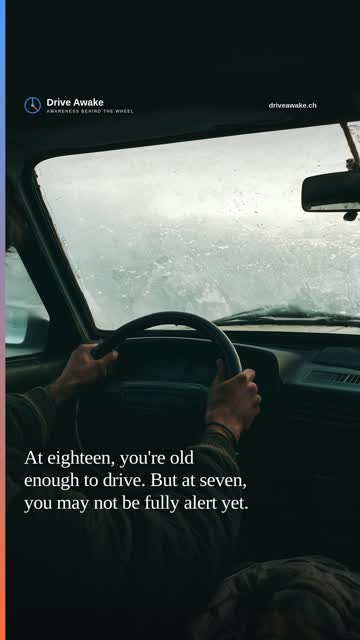
At eighteen, you're old enough to drive. But at seven, you may not be fully alert yet.

Two mechanisms add up: evening melatonin starts later, and sleep pressure builds more slowly, so in the evening you stay awake longer and in the morning the body is still in its night. In mature adolescents sleep pressure rises with a time constant of 15.4 hours, against 8.9 in children before puberty (Jenni 2005). At 7, for an eighteen-year-old, alertness is still close to its minimum.

Watch this passage (0:14) →
Not laziness · 0:20
0:20 · Not laziness

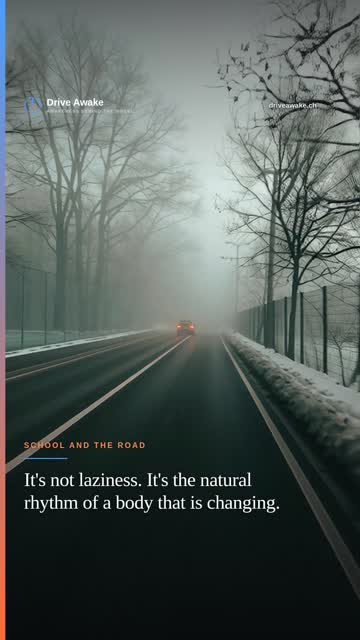
It's not laziness. It's the natural rhythm of a body that is changing.

Screens in the evening, free weekend hours and caffeine amplify the delay, but do not cause it. After twenty, the delay reverses on its own, without anyone changing habits: Roenneberg proposes it as the first biological marker of the end of adolescence (Roenneberg 2004).

Watch this passage (0:20) →
Behind the wheel · 0:27
0:27 · Behind the wheel

And when that body gets behind the wheel, sleepiness is everyone's business.

A sleepy teenager in the morning is not a discipline problem. Understanding this changes how a family organises departures, sleep hours and who drives when.

Watch this passage (0:27) →

What helps

First of all, believe it: the delay belongs to the body, not to character. Natural light in the morning brings the clock back, and most of all in late rhythms (Wright 2013). Screens off an hour before sleep let melatonin start (Chang 2015). At the weekend, waking no more than two hours later than usual avoids Monday's jet lag.

Transcript
  1. 0:01 Seven o'clock, outside the school. But for many teenagers, the body still thinks it's night.
  2. 0:08 In the teenage years, the body clock shifts later. You fall asleep later, and waking up gets harder.
  3. 0:15 At eighteen, you're old enough to drive. But at seven, you may not be fully alert yet.
  4. 0:22 It's not laziness. It's the natural rhythm of a body that is changing.
  5. 0:28 And when that body gets behind the wheel, sleepiness is everyone's business.
  6. 0:35 At eighteen you can drive. But you still need to sleep. Protect your sleep before you leave.

Captions IT FR DE EN

Share this episode

The episode may be shared in full, as it is, with the Drive Awake signature and the link to this page. No cuts, no re-editing, no replacement of the audio, no advertising. The images are generated and declared as such. All rights remain with Drive Awake / Opening.

Paste this code: the video stays on the platform, with its signature.

Sources

  • Fischer D, Lombardi DA, Marucci-Wellman H, Roenneberg T. Chronotypes in the US - influence of age and sex. PLoS ONE 2017;12:e0178782. DOI: 10.1371/journal.pone.0178782 laboratory
  • Roenneberg T, Kuehnle T, Pramstaller PP, et al. A marker for the end of adolescence. Curr Biol 2004;14:R1038-R1039. DOI: 10.1016/j.cub.2004.11.039 laboratory
  • Jenni OG, Achermann P, Carskadon MA. Homeostatic sleep regulation in adolescents. Sleep 2005;28:1446-1454. DOI: 10.1093/sleep/28.11.1446 laboratory
  • Wright KP Jr, McHill AW, Birks BR, Griffin BR, Rusterholz T, Chinoy ED. Entrainment of the human circadian clock to the natural light-dark cycle. Curr Biol 2013;23:1554-1558. DOI: 10.1016/j.cub.2013.06.039 laboratory
  • Chang AM, Aeschbach D, Duffy JF, Czeisler CA. Evening use of light-emitting eReaders negatively affects sleep, circadian timing, and next-morning alertness. Proc Natl Acad Sci USA 2015;112:1232-1237. DOI: 10.1073/pnas.1418490112 laboratory

Related

  1. 00
  2. 01
  3. 02
  4. 03
  5. 04
  6. 05
  7. 06
  8. 07
  9. 08
  10. 09
  11. 10
  12. 11
  13. 12
  14. 13
  15. 14
  16. 15
  17. 16
  18. 17
  19. 18
  20. 19
  21. 20
  22. 21
  23. 22
  24. 23

2026-09-08 · Drive Awake