Circadian Adapted
This website adapts color temperature to your local time, reducing blue light exposure during evening hours.
Awareness Behind the Wheel
Drive Awake Awareness Behind the Wheel driveawake.ch
← The 24 Hours · All hours
Episode 10:00 Draft

Full alertness

Draft under review · open-air workshop · the campaign starts in November 2026

Watch in ITFRDEEN

At ten, your body is on your side. Leave now, not after lunch.

In mid-morning the two forces of sleep pull together: the need for sleep is low after the night, the body clock pushes towards the day, the brain has got going. It is the good hour for the long trip. On two conditions: having slept, and knowing that the peak does not come at the same hour for everyone.

In the video

  1. 0:00Ten o'clock
  2. 0:07The two forces
  3. 0:15Getting going
  4. 0:22Three peaks
  5. 0:30Early birds and night owls
  6. 0:38Without the night
  7. 0:45The person
  8. 0:52The message

Details 65 s · 9:16 · four languages · generated and declared images · 2026-09-09 · Drive Awake

The video explained

0:00 · Ten o'clock

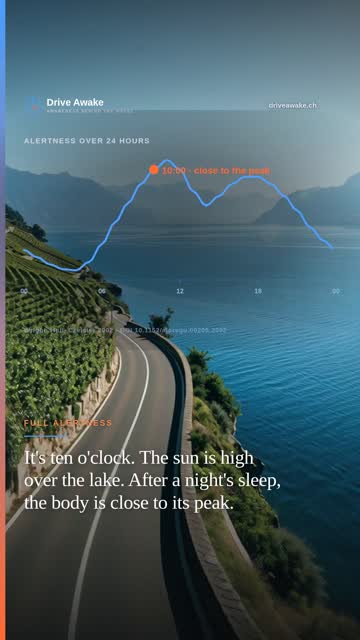
It's ten o'clock. The sun is high over the lake. After a night's sleep, the body is close to its peak.

It is the curve of episode 04, seen from the other side. Alertness follows body temperature: it bottoms out shortly before dawn and climbs all morning (Wright 2002). By ten the climb is almost done. It is not a safe hour, because a safe hour does not exist: it is the hour when the body is on the driver's side. Provided it has slept.

Wright, Hull, Czeisler 2002 · DOI 10.1152/ajpregu.00205.2002

Watch this passage (0:00) →
The two forces · 0:07
0:07 · The two forces

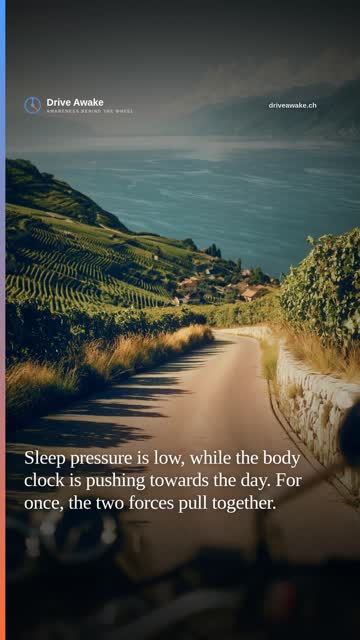
Sleep asks for little, the body clock pushes towards the day. For once, the two forces pull together.

Sleep has two forces. The first is the need for sleep: it grows with the hours spent awake and clears with sleep (the adenosine of episode 09). At ten, after a full night, it is at its lowest point of the day. The second is the body clock, which keeps us awake by day and pushes us to sleep at night: at ten it is rising. At night the two forces add up against the driver (episodes 03 and 04). In mid-morning they add up in the driver's favour. It is the widest window of the day.

Watch this passage (0:07) →
Getting going · 0:15
0:15 · Getting going

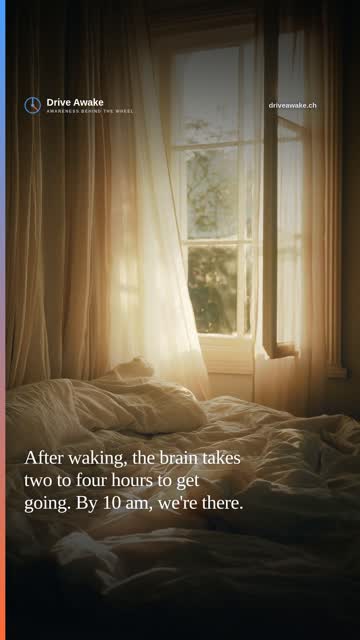
After waking, the brain takes two to four hours to get going. By ten, we're there.

Right after waking we are not immediately clear-headed: that is sleep inertia, and it fades slowly. Those who measured it on three consecutive days, in people getting up at their usual time, saw that it takes two to four hours to get back to full capacity; the feeling of being awake comes first, readiness later (Jewett 1999). Getting up, showering, having breakfast, switching on the light: none of it shortened the process. Whoever leaves at seven is still driving inside the inertia. By ten it is long gone. That is why the first trip of the morning is not the best one, even after a good night.

Watch this passage (0:15) →
0:22 · Three peaks

Sleepiness-related crashes have three peaks: at two, at six and at four in the afternoon. Ten isn't one of them.

On real roads, in England, crashes where sleepiness is the most likely explanation cluster around three hours: two at night, six in the morning, four in the afternoon (Horne and Reyner 1995). They make up 16% of crashes on the major roads studied and over 20% on the motorways, mostly men under thirty. At the three peaks at least one of the two forces is pulling the wrong way: the night, dawn, the dip after lunch (episode 13). Mid-morning stays outside all three. The ring is the one from episode 04, where the 02-06 window lit up: here the bright part of the day lights up.

Horne, Reyner 1995 · DOI 10.1136/bmj.310.6979.565

Watch this passage (0:22) →
0:30 · Early birds and night owls

The peak doesn't come at the same hour for everyone: earlier for early birds, later for night owls.

The body clock does not show the same time for everyone. Extreme early birds wake up when extreme night owls go to sleep: it is called chronotype, it is partly written in the genes and is measured by when people sleep on free days (Roenneberg 2003). The best moment of the day shifts with chronotype: in tests of attention and memory, people do better when the time of the test matches the time of their own clock (Schmidt 2007). For a night owl, ten is still a climb; for an early bird it is already the peak. Adolescents are almost all night owls, for biological reasons (episode 07). Everyone has a good hour. It is not the same for everyone.

Roenneberg 2003; Schmidt 2007 · DOI 10.1177/0748730402239679

Watch this passage (0:30) →
Without the night · 0:38
0:38 · Without the night

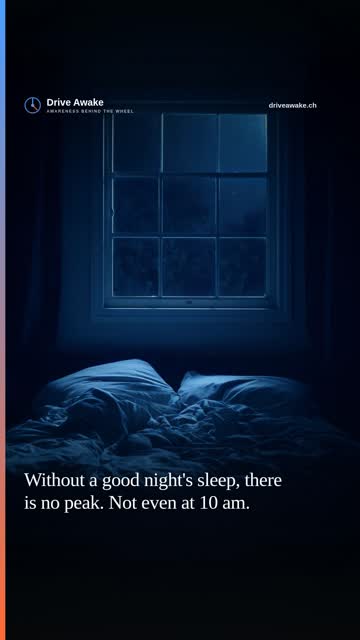
Without a night's sleep there is no peak. Not even at ten.

The two forces pull together only if the night has cleared the need for sleep. Those who sleep little carry it through the day too, and the clock alone is not enough to cover it. Two weeks of six hours' sleep a night left readiness at the level of one or two nights without sleep; and the people living it said they felt only a little sleepy (Van Dongen 2003). It is the trap of episodes 08 and 09: the sleepiness you feel and the sleepiness that is there do not match. The ten o'clock peak is made the night before.

Watch this passage (0:38) →
The person · 0:45
0:45 · The person

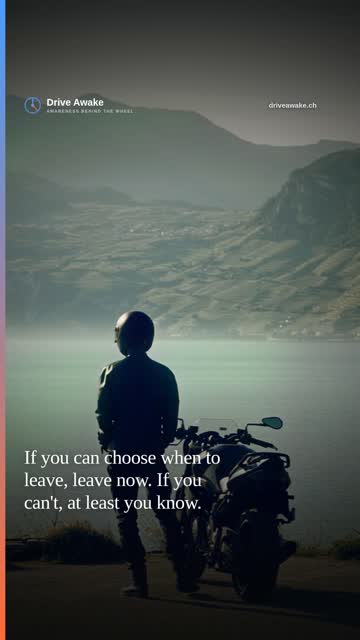
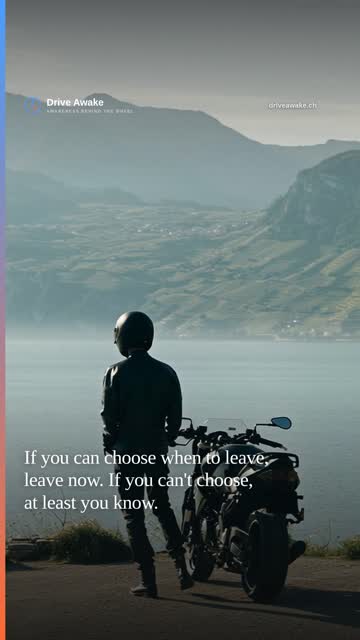
If you can choose when to leave, leave now. If you can't choose, at least you know.

The motorcyclist on the lake road has nothing to prove: he chose the hour. People who drive for a living often cannot choose: shifts, deliveries, timetables. Knowing the curve helps both. The first, to put the long trip in the good hour; the second, to know in which hours he can ask more of himself and in which he must stop (episodes 05, 06, 16). The motorbike is this episode's vehicle because it forgives a distraction less than anything else, and because at ten on a sunny day it is the most honest picture of full alertness.

Watch this passage (0:45) →

What helps

If you can choose, the long trip goes in mid-morning: after the brain has got going (two to four hours after waking: Jewett 1999) and before the dip after lunch (episode 13). Night owls shift the window an hour or two later (Roenneberg 2003; Schmidt 2007). The good hour does not replace the night: those who slept little do not have one (Van Dongen 2003), and then the rules of the other episodes apply: stop, sleep twenty minutes, get someone else to drive. And the peak passes: around four in the afternoon one of the three worst moments returns (Horne and Reyner 1995). With the circadian signal you can work out your trip: when you leave, how long you drive.

Transcript
  1. 0:02 It's ten o'clock. The sun is high over the lake. After a night's sleep, the body is close to its peak.
  2. 0:08 Sleep asks for little, the body clock pushes towards the day. For once, the two forces pull together.
  3. 0:16 After waking, the brain takes two to four hours to get going. By ten, we're there.
  4. 0:24 Sleepiness-related crashes have three peaks: at two, at six and at four in the afternoon. Ten isn't one of them.
  5. 0:31 The peak doesn't come at the same hour for everyone: earlier for early birds, later for night owls.
  6. 0:39 Without a night's sleep there is no peak. Not even at ten.
  7. 0:46 If you can choose when to leave, leave now. If you can't choose, at least you know.
  8. 0:53 At ten, your body is on your side. Leave now, not after lunch.

Captions IT FR DE EN

Draft under review · the campaign starts in November 2026

This episode is a draft: we reread it and correct it before final publication. A mistake, a line that doesn't sound right, a figure worth checking: tell us below. We're getting this campaign right together.

Help us fix the mistakes
We keep nothing beyond what you write here.

Share this episode

The episode may be shared in full, as it is, with the Drive Awake signature and the link to this page. No cuts, no re-editing, no replacement of the audio, no advertising. The images are generated and declared as such. All rights remain with Drive Awake / Opening.

Paste this code: the video stays on the platform, with its signature.

Sources

  • Wright KP Jr, Hull JT, Czeisler CA. Relationship between alertness, performance, and body temperature in humans. Am J Physiol Regul Integr Comp Physiol 2002;283:R1370-R1377. DOI: 10.1152/ajpregu.00205.2002 laboratory
  • Jewett ME, Wyatt JK, Ritz-De Cecco A, Khalsa SB, Dijk DJ, Czeisler CA. Time course of sleep inertia dissipation in human performance and alertness. J Sleep Res 1999;8:1-8. DOI: 10.1111/j.1365-2869.1999.00128.x laboratory
  • Horne JA, Reyner LA. Sleep related vehicle accidents. BMJ 1995;310:565-567. DOI: 10.1136/bmj.310.6979.565 road
  • Roenneberg T, Wirz-Justice A, Merrow M. Life between clocks: daily temporal patterns of human chronotypes. J Biol Rhythms 2003;18:80-90. DOI: 10.1177/0748730402239679 laboratory
  • Schmidt C, Collette F, Cajochen C, Peigneux P. A time to think: circadian rhythms in human cognition. Cognitive Neuropsychology 2007;24:755-789. DOI: 10.1080/02643290701754158 laboratory
  • Van Dongen HPA, Maislin G, Mullington JM, Dinges DF. The cumulative cost of additional wakefulness: dose-response effects on neurobehavioral functions and sleep physiology from chronic sleep restriction and total sleep deprivation. Sleep 2003;26:117-126. DOI: 10.1093/sleep/26.2.117 laboratory

Related

  1. 00
  2. 01
  3. 02
  4. 03
  5. 04
  6. 05
  7. 06
  8. 07
  9. 08
  10. 09
  11. 10
  12. 11
  13. 12
  14. 13
  15. 14
  16. 15
  17. 16
  18. 17
  19. 18
  20. 19
  21. 20
  22. 21
  23. 22
  24. 23

2026-09-09 · Drive Awake